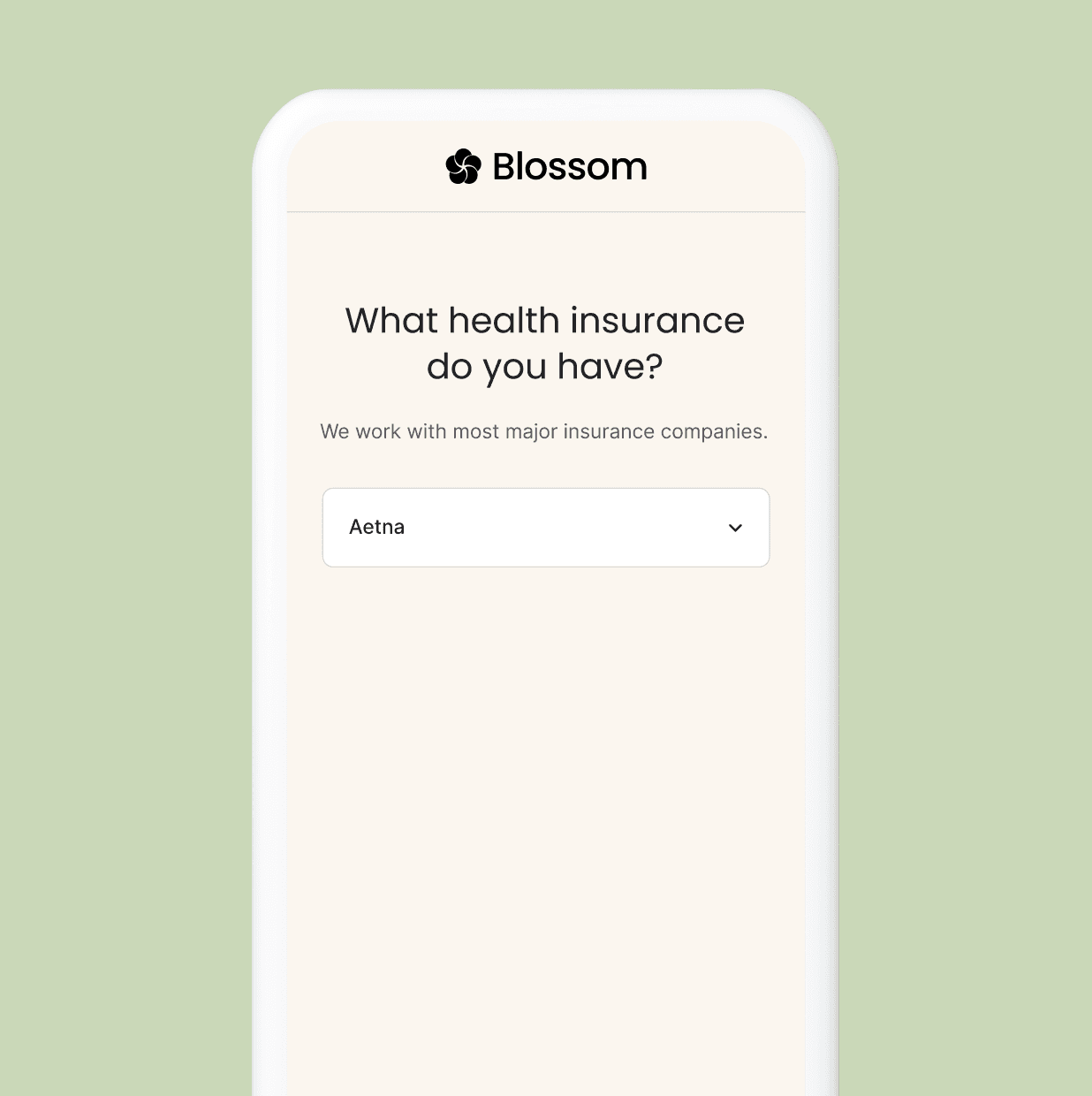
See if Escitalopram (Lexapro) is Right for You, Covered by Insurance

See if Escitalopram (Lexapro) is Right for You, Covered by Insurance

See if Escitalopram (Lexapro) is Right for You, Covered by Insurance

Meet with one of our board-certified, licensed providers to see if Escitalopram (Lexapro) is right for you.

Meet with one of our board-certified, licensed providers to see if Escitalopram (Lexapro) is right for you.

Meet with one of our board-certified, licensed providers to see if Escitalopram (Lexapro) is right for you.

Most patient copays $0-$22

Why Blossom Health

Care that’s covered

All our psychiatrists take insurance.

Flexible Scheduling

Virtual visits make showing up easy.

Responsible prescribing

Medication, only as needed.

What we specialize in

The core mental health conditions we treat.

  • Anxiety Disorders

  • Depression

  • Dissociative Disorders

  • Gender Identity & Dysphoria

  • ADHD

  • Autism

  • Dyslexia

  • Dyslexia

  • Bipolar Disorder

  • Panic Disorder

  • Social Anxiety

  • Substance Use Disorders

  • Family Conflict

  • Grief

  • LGBTQ

  • Learning Disabilities

  • Men's Issues

  • Mood Disorders

  • Obsessive-Compulsive (OCD)

  • Parenting

Psychiatry transformed for everyone

Psychiatry transformed for everyone

Psychiatry transformed for everyone

Our clinical team is led by experts in the field, adheres to the highest standards of care, and represents a diverse range of specialties and identities.

Our clinical team is led by experts in the field, adheres to the highest standards of care, and represents a diverse range of specialties and identities.

Our clinical team is led by experts in the field, adheres to the highest standards of care, and represents a diverse range of specialties and identities.

How it works

1

Tell us a bit about your needs

It only takes 5 minutes to help us get you the care you deserve

2

Meet your psychiatrist

We’ll help match you with a psychiatrist on our team who fits your needs, schedule, and insurance

3

Get the care you need

You’ll have your first virtual visit in days and start collaborating on your care with your provider

1

Tell us a bit about your needs

It only takes 5 minutes to help us get you the care you deserve

2

Meet your psychiatrist

We’ll help match you with a psychiatrist on our team who fits your needs, schedule, and insurance

3

Get the care you need

You’ll have your first virtual visit in days and start collaborating on your care with your provider

1

Tell us a bit about your needs

It only takes 5 minutes to help us get you the care you deserve

2

Meet your psychiatrist

We’ll help match you with a psychiatrist on our team who fits your needs, schedule, and insurance

3

Get the care you need

You’ll have your first virtual visit in days and start collaborating on your care with your provider

FAQ

FAQ

FAQ

Can’t find what you’re looking for? Contact us here: hello@joinblossomhealth.com

Can’t find what you’re looking for? Contact us here: hello@joinblossomhealth.com

Can’t find what you’re looking for? Contact us here: hello@joinblossomhealth.com

What is Blossom Health?

What is Blossom Health?

What is Blossom Health?

Who is Blossom Health for?

Who is Blossom Health for?

Who is Blossom Health for?

Where does Blossom Health operate?

Where does Blossom Health operate?

Where does Blossom Health operate?

How do I sign up and schedule my first session?

How do I sign up and schedule my first session?

How do I sign up and schedule my first session?

What do I need to do prior to my first session?

What do I need to do prior to my first session?

What do I need to do prior to my first session?

What will my first appointment be like?

What will my first appointment be like?

What will my first appointment be like?

What is Escitalopram (Lexapro)?

Escitalopram is a prescription antidepressant that belongs to a class of medications called selective serotonin reuptake inhibitors (SSRIs). Escitalopram works by increasing the amount of serotonin—a neurotransmitter that helps regulate mood, sleep, and appetite—available in the brain.

Unlike older antidepressants, escitalopram specifically targets serotonin without significantly affecting other brain chemicals. This selective action typically results in fewer side effects compared to older medication classes like tricyclic antidepressants or monoamine oxidase inhibitors (MAOIs).

When you take escitalopram, it blocks the reuptake (reabsorption) of serotonin by nerve cells, allowing more of this mood-regulating chemical to remain active in the spaces between neurons. This increased serotonin activity can help improve mood, reduce anxiety, and alleviate other symptoms of mental health conditions.

Uses and Conditions of Lexapro

Escitalopram has been extensively studied and approved by the FDA for treating several mental health conditions.

Major Depressive Disorder

Escitalopram is considered a first-line treatment for depression, with research showing that people with depression experience significant improvement when taking SSRIs like escitalopram. Studies suggest escitalopram may be one of the most effective and well-tolerated SSRIs for treating depression.

Generalized Anxiety Disorder (GAD)

Escitalopram is FDA-approved for treating generalized anxiety disorder, characterized by chronic worry and anxiety that interfere with daily life. Research demonstrates that escitalopram can significantly reduce anxiety symptoms and improve quality of life for people with GAD.

Off-Label Uses

Healthcare providers may also prescribe escitalopram for conditions not officially FDA-approved, including:

  • Social anxiety disorder

  • Panic disorder

  • Obsessive-compulsive disorder (OCD)

  • Post-traumatic stress disorder (PTSD)

  • Premenstrual dysphoric disorder (PMDD)

Escitalopram has been extensively studied and approved by the FDA for treating several mental health conditions.

Major Depressive Disorder

Escitalopram is considered a first-line treatment for depression, with research showing that people with depression experience significant improvement when taking SSRIs like escitalopram. Studies suggest escitalopram may be one of the most effective and well-tolerated SSRIs for treating depression.

Generalized Anxiety Disorder (GAD)

Escitalopram is FDA-approved for treating generalized anxiety disorder, characterized by chronic worry and anxiety that interfere with daily life. Research demonstrates that escitalopram can significantly reduce anxiety symptoms and improve quality of life for people with GAD.

Off-Label Uses

Healthcare providers may also prescribe escitalopram for conditions not officially FDA-approved, including:

  • Social anxiety disorder

  • Panic disorder

  • Obsessive-compulsive disorder (OCD)

  • Post-traumatic stress disorder (PTSD)

  • Premenstrual dysphoric disorder (PMDD)

Alternative Treatment Options

If escitalopram isn't the right fit for you, numerous effective alternatives exist for treating depression and anxiety.

Other SSRI Medications

  • Sertraline (Zoloft): Approved for a broader range of conditions including PTSD, OCD, panic disorder, and social anxiety disorder.

  • Fluoxetine (Prozac): Often causes fewer sexual side effects and has a longer half-life, making discontinuation easier.

  • Paroxetine (Paxil): Effective for multiple anxiety disorders, though it may cause more discontinuation symptoms.


Are you a provider?

Are you a provider?

Are you a provider?

Join our supportive, dedicated, provider-first
community of MDs, DOs, and PMHNPs

Join our supportive, dedicated, provider-first
community of MDs, DOs, and PMHNPs

Join our supportive, dedicated, provider-first
community of MDs, DOs, and PMHNPs

If you or someone you know is experiencing an emergency or crisis and needs immediate help, call 911 or go to the nearest emergency room. Additional crisis resources can be found here.

If you or someone you know is experiencing an emergency or crisis and needs immediate help, call 911 or go to the nearest emergency room. Additional crisis resources can be found here.

If you or someone you know is experiencing an emergency or crisis and needs immediate help, call 911 or go to the nearest emergency room. Additional crisis resources can be found here.